
Working Equitation
Description of the obstacles
Obstacles in Working Equitation appear in the Ease of Handling and Speed tests.
These tests show the horse’s composure and obedience and the rider’s skill in negotiating obstacles that can be met in open country.
All obstacles must be safe for horse and rider. Slippery surfaces, sharp edges, dangerous ropes etc. are not allowed. If an obstacle is deemed dangerous, it must be removed from the competition – the decision rests with the President of the Ground Jury.
A test may consist of up to 15 obstacles from the list below.
The short descriptions below apply to the most difficult class, Masters. In the lower, easier classes the way obstacles are ridden, their dimensions and the gait depend on the class of the competition – see the “Competition classes” table – LINK
Want to know the detailed rules for riding the obstacles and the reasons for disqualification?
Be sure to check the “Description of riding the obstacles” – LINK
1. Figure of eight between barrels

This obstacle consists of 2 barrels placed 3 m apart (measured from the centre of the barrels).
The horse enters between the barrels in canter and circles the right-hand barrel; halfway between the barrels it makes a flying change, then circles the left-hand barrel to the left. Finishing the left-hand circle, the rider must cross the line halfway between the barrels.
The obstacle may be ridden in reverse, starting with a circle around the right-hand barrel.
Assessment
The judges assess the precision, shape and symmetry of the circles, the horse’s response to the aids and the quality of the flying change.

2. Bridge

This obstacle consists of a wooden bridge made of planks that the horse must cross.
The obstacle should be at least 4 m long x 1.5 m wide and 20–50 cm above the ground, and must be built of materials that pose no danger to horse or rider; its surface must not be slippery. The bridge should be close to natural colours. Sponsors’ logos on the sides are not allowed if they could prevent the judges from assessing the round correctly.
The obstacle is ridden in walk.
Assessment
The judges assess the quality and regularity of the walk over the obstacle, the quality of the transitions and the horse’s confidence in approaching the obstacle.

3. Serpentine

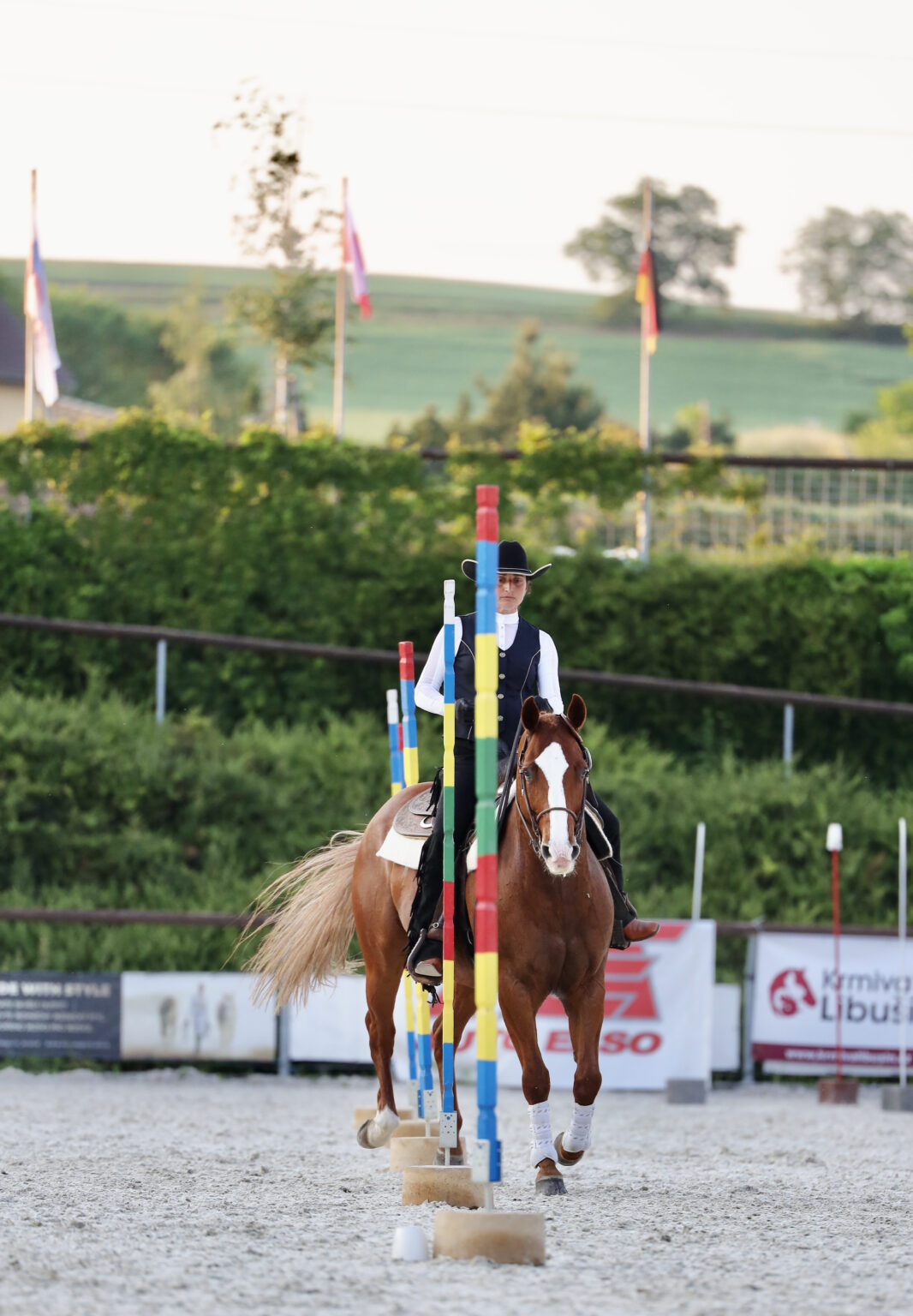
Also called the parallel slalom. This obstacle consists of 7 poles 2 m high set in 2 parallel lines, with the poles 6 m apart.
How it is ridden: the horse makes half-circles in canter around the poles in the order shown by their numbers (1.2.3.4.5.6.7) and in the direction shown on the course plan, with flying changes halfway between the poles.
Assessment
The judges assess fluency, harmony and precision, the rider’s use of the aids, the quality of the flying changes and symmetry.

4. Jump over straw bales

This obstacle consists of 4 straw bales placed under a pole between two wings at a height of up to 50 cm. The horse should take the obstacle in canter, naturally and without resistance. The straw bales may be replaced by another natural material.
Assessment
The judges assess the horse’s calmness and confidence in approaching the obstacle, the way it is jumped and the rider’s use of the aids. A knock-down results in a negative mark.

5. Pen

This obstacle consists of a circular fence 6 m in diameter with an entrance, inside which there is a second fence that may hold live or artificial animals such as hens, geese, ducks, cows etc. The corridor is 1.5 m wide.
How it is ridden: enter in one direction, ride a full circle, exit, perform a half-pirouette or half-volte and re-enter (in the opposite direction to the first entry), ride another full circle and leave the pen. The obstacle may be ridden in walk or canter.
Assessment
The judges assess the horse’s calmness and confidence in approaching the obstacle and the way it is ridden.

6. Straight-line slalom

This obstacle consists of 5 poles 2 m high set in a straight line 6 m apart. The direction is set by markers on the course. The obstacle is ridden in canter. Every change of direction involves a flying change. The horse should always canter on the correct lead for the turn being ridden. Changes should always be made halfway between the poles.
Assessment
The judges assess fluency, harmony and precision, the rider’s use of the aids, the quality of the flying changes and symmetry.
7. Three barrels

This obstacle consists of 3 barrels placed at the corners of an equilateral triangle (3 m between barrels, measured from their centres).
How it is ridden: the horse enters the obstacle in canter, circles the right-hand barrel to the right (full circle), then circles the next barrel to the left (partial circle) and circles the last barrel to the right (full circle), leaving the obstacle at the same point where it entered. Every change of direction involves a flying change at set points.
The aim of this obstacle is to show the horse’s handiness and its ability to work in tight spaces while keeping impulsion and canter rhythm.
Assessment
The judges assess fluency, harmony and precision (the figure), the rider’s use of the aids and the quality of the flying changes.

8. Gate

The gate, at least 2 m wide, should be made of wood or metal mesh and closed with a metal loop.
The gate may open to the right or to the left, according to the course.
How it is ridden: the horse approaches in canter at right angles to the obstacle and takes the last few strides in walk, showing confidence and calmness. The rider positions the horse sideways to the gate (to the left or right, depending on which way the gate opens).
Using the right hand (or the left – for riders using the left hand in the test), the rider lifts the metal loop and opens the gate, then rides through in walk; when the horse is completely on the other side, the rider replaces the loop to finish the obstacle (the rider may step back one or two strides to close the gate).
Possible variant – riding the gate backwards.
In the speed test the gate is usually closed with a rope (see photo)
Assessment
The judges assess how the horse approaches the obstacle and the fluency with which it is ridden. The horse should show no lack of confidence or disobedience. The rider’s movements should be relaxed and precise, using the aids correctly to move the horse forward or sideways when needed. The rider must not let go of the gate while riding the obstacle.


9. Bell at the end of a corridor

This obstacle consists of 2 poles about 4 m long on 2 supports about 0.60 m high and 1.50 m apart, forming a corridor, with a bell at the end of the corridor at a height of about 2 m.
How it is ridden: the rider enters the obstacle in walk or canter, halts at the end of the corridor, rings the bell and then reins back out. The obstacle is complete when all four of the horse’s legs are outside the corridor.
Alternatively, the corridor may be L-shaped, formed by two 4 m corridors.
Assessment
The judges assess how the horse approaches the obstacle, the fluency with which it is ridden and the rider’s use of the aids. If the horse moves or knocks down any part of the obstacle, the mark is lowered.

10. Clay jug

This obstacle consists of a table about 1 m high with a round or square top on which stands a jug filled with liquid (water).
How it is ridden: the rider approaches the table in canter or walk, picks up the jug (may show drinking from it), lifts it clearly above the head and puts it back on the table.
Assessment
The judges assess how the horse approaches the obstacle, its immobility and how the rider performs the task. After being put back, the jug must stay standing.
A bottle filled with liquid or sand may be used instead of a jug.

11. Reining back

2 lines of 3 poles forming a corridor, with 3 m between the poles in each line and 1.5 m between the lines.
How it is ridden: the rider enters in walk or canter between the lines of poles up to the last pole, halts, takes the cup, then reins back in a slalom between the poles and places the cup on the first pole.
To complete the exercise, the horse must be entirely (i.e. with all four legs) in front of the line of the first pair of poles (completely out of the obstacle area).
If the rider uses the right hand to ride the horse, the cup is taken from the left pole and placed on the last pole on the left. If the rider uses the left hand, the cup is taken from the right pole and placed on the last pole on the right.
Assessment
The judges assess how the horse enters the obstacle, the correctness of the halt, the fluency of the rein-back and the response to the aids. Touching or knocking down parts of the obstacle lowers the mark considerably.

12. Side pass over a log

There are several variants of this obstacle. Most often it consists of a log 3–6 m long on supports 5–10 cm high, or 2 logs placed parallel or at 90º to each other.
How it is ridden: the horse approaches the log at right angles (from the right or left, as shown on the course plan) and crosses it in half-pass in walk or canter. While being crossed, the log should always be between the horse’s front and hind legs and must not be touched or knocked off its supports.
Assessment
The judges assess the horse’s ability to negotiate the obstacle, the fluency and continuity of its movement and its confidence. Canter scores higher than walk. The mark is lowered considerably if the horse touches or knocks down the log.

13. Taking the pole from the barrel

How it is ridden: the rider approaches the barrel (or the container holding the pole) in canter and takes out the pole. The horse should stay in a calm, rhythmic canter throughout, with no change of rhythm or hesitation while the pole is taken.
Assessment
The judges assess how the horse approaches the obstacle, its reaction to the movement of the pole and the confident, relaxed way the rider takes the pole. Any change of rhythm or knocking over the barrel lowers the mark.

14. Placing the pole in the barrel
This obstacle is ridden like no. 13, except that the pole is placed into the barrel.
Assessment
The judges assess how the horse approaches the obstacle, its reaction to the movement of the pole and the confident, relaxed way the rider places the pole. Any change of rhythm or knocking over the barrel lowers the mark.
A rider who drops the pole before placing it in the barrel may not continue the round, on pain of disqualification. To resolve the situation, the rider must dismount, pick up the pole, put it in the barrel from the saddle and only then continue the round.

15. Ring spearing – the bull

Staying in canter, the rider takes with the pole a ring 15 cm in diameter placed on the bull
Assessment
The judges assess whether the horse keeps its pace and stays straight, its fluency and confidence at the moment the rider takes the ring. A change of rhythm with loss of fluency lowers the mark, as do deviations from the line.
Exercises 13, 14 and 15 may be judged as one exercise.

17. Bank
This is the same obstacle as in cross-country: it starts with a ramp leading up to a platform about 2 m long, no more than 60 cm above the ground, ending with a vertical drop.
ASSESSMENT
The judges assess the horse’s confidence in approaching the obstacle and the way it is negotiated without excessive use of the aids or effort by the rider.
The mark is lowered if the horse waits too long and is reluctant to jump or step down from the obstacle

16. Water crossing
The obstacle is ridden in walk. The water ditch is no more than 20 cm deep.
The horse should cross the ditch naturally, as if it had not noticed it, demonstrating its experience in crossing water. Riding this exercise correctly is essential for every horse working in open country.
Assessment
The judges assess the horse’s confidence in approaching the obstacle and the calm, fluent way it is negotiated without excessive use of the aids or effort by the rider.
18. Moving a cup from the top of one pole to another

The obstacle consists of two poles 2 m high placed 1.2 m apart. A cup is placed on one of the poles. The rider halts between the poles, moves the cup from one pole to the other and then leaves the obstacle in canter going forward.
If the rider uses the right hand to ride the horse, the cup is moved from the left pole to the right. If the rider uses the left hand, the cup is moved from the right pole to the left.
Assessment
The judges assess the horse’s confidence in approaching the obstacle without the rider needing strong aids, the halt and the horse’s immobility while the cup is moved.

Example of a championship-level speed test
Any questions?
Get in touch
We are happy to help with competitions, licences, training and WEP membership.